


TL:DR/ Executive Summary:
Reflecting on Brian McLaren’s new sci-fi novel The Last Voyage, this post explores a broader trend among deconstructing Christians who shift their focus from theology to causes like environmentalism. While recognizing McLaren’s influence and generosity, I critique how progressive faith often replaces God with activism, leaving a void only true faith can fill. The piece ultimately affirms that while causes matter, the Gospel offers something deeper—a life renewed through surrender to God.
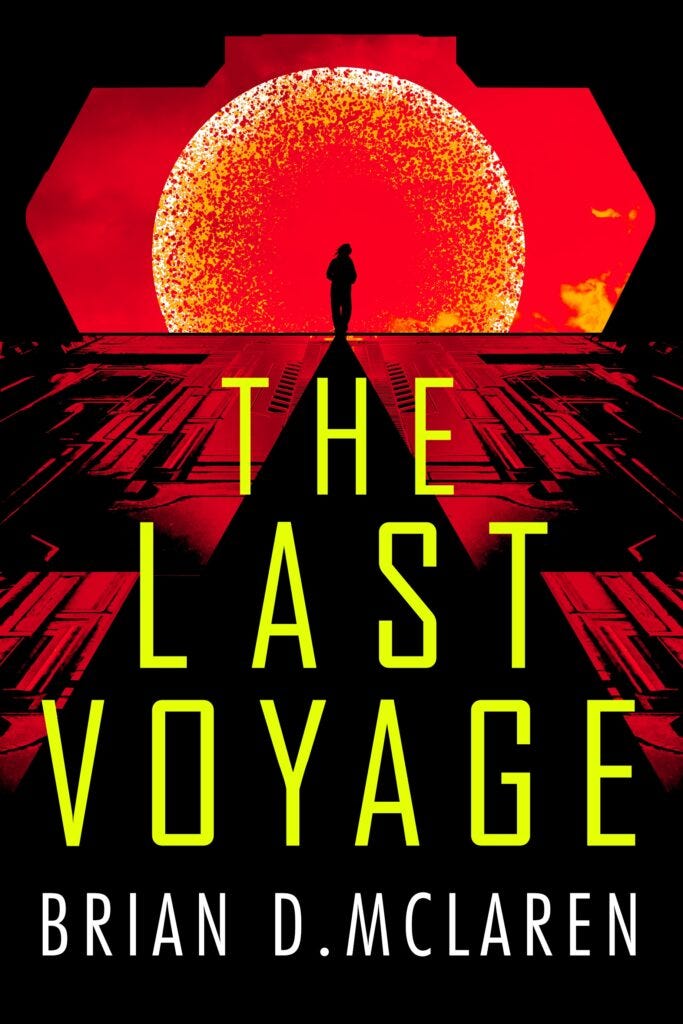
A few months back, I received an email from a publicist for Brian McLaren about his new book, The Last Voyage, asking if I’d be interested in having McLaren on the Future Christian Podcast again.1
The book description is as follows:
It’s 2056 and international oligarchs have pushed the world to the precipice of ecological, economic, and nuclear catastrophe.
But two philanthropists have teamed up to establish a viable outpost on Mars.
Could this daring outpost be the next chapter in the story of the human race? Or will its brilliant team of scientists and engineers repeat the folly of humans on Earth?
When the project’s founders on Earth discover that Mars Base has been keeping a terrifying, multi-layered secret from them, they recruit an unusual crew for a last voyage. Will these young voyagers bring what’s needed for the fledging community on Mars to flourish?
In this first volume in a thrilling new trilogy from Brian McLaren, you’ll explore the limits of technology, the deepest needs of the human spirit, and the abiding questions that energize humans wherever they live … on Earth or elsewhere in space.
I didn’t respond to the email.
Anyone remotely paying attention can see this is a not-so-subtle commentary on the billionaire space race between Elon Musk and Jeff Bezos. And while it’s optimistic to assume they’ll both still be around in 2056, when money isn’t an obstacle, who knows?
Regardless, I wasn’t interested.
My podcast is essentially about ecclesiology—meaning, Martha Tatarnic and I are focused on the future of the church. And while McLaren has been incredibly influential in reshaping conversations about church over the past 25 years, I didn’t feel like wading through what, from the outside, felt like a tedious and predictable novel just to get to a few questions about faith and church in America.
Maybe I should have. McLaren is, as I’ve said before, an incredible person—kind and generous in every interaction I’ve had with him. He came on my podcast years ago when I was just starting out and he didn’t know me from Adam. I can perhaps assuage my conscience in that he surely doesn’t need my little podcast to get the word out about his book.
The Church Doesn’t Need More Influencers—It Needs Faithful Leaders

“One of the most effective ways a church can prevent spiritual abuse is by seeking leaders with integrity over talent, character over charisma, and maturity over verbal eloquence.”
But it’s not personal. It’s that McLaren’s shift from theology to environmentalism mirrors a pattern I’ve seen repeatedly among those deconstructing from Christianity. I’m reminded of Tim Whitaker from The New Evangelicals, who rose to prominence by (fairly) calling out the hypocrisies of conservative Christians. Eventually, though, it becomes less about theology and more about politics or social causes.
It seems like many who deconstruct still need something “bigger than themselves” to live for. That’s where causes like environmentalism or politics come in—not as bad things, but as replacements for God. I find it noteworthy that as Ryan Burge notes, Atheists have the highest level of political participation.

That’s the problem with deconstruction or progressive Christianity—though they aren’t synonymous, they often end up in the same place: with a diminished view of God and the Gospel. Good things—otherwise known as grace and mercy—coming to the world depend on our own human action, not God’s. I remember in the early days of my own deconstruction, I too became obsessed with environmental issues. And to be clear, I still believe in being a good steward of God’s creation. The difference is, I no longer see the earth as ultimate.
No, I don’t think God is going to destroy the earth in a fireball. No, I don’t believe ignoring politics is faithful—I literally called my congressman today , I recycle, and I have solar on my roof. But at the end of the day, I believe there is something bigger than politics or climate change.
And yes, I get that “trust God” can be used as an excuse for inaction. But at some point, faith demands that we do exactly that—trust.
Within deconstruction or progressive circles, God often ceases to matter. And that void creates a hunger for something transcendent to give ourselves to. As Augustine—or the 90s CCM band Plumb—famously put it: “Our hearts are restless until they rest in You / There’s a God-shaped hole in all of us.”
One of the biggest misconceptions about Christianity is that it uniquely requires you to give your life away. That assumption is only half right. We all give our lives to something. The difference with the way of Jesus is this: in giving your life, you receive it back—renewed, restored, and reoriented.
That’s the beauty of the Gospel.
I was tempted to link my past podcast conversations with McLaren here, but I thought that would be a bit hypocritical. If you want to hear them, you can find them.
What an awful time to be pulled into politics as something “ultimate.” But seriously, I felt myself being drawn in that way through my deconstruction and it caused a lot of anxiety. Honestly, psychology of all things helped me to keep God as the ultimate point of reference for my life, specifically, the IFS view that we all have a Self that is calm, compassionate, present etc—all attributes that reflect God. If there is a reflection of God in us that we can really experience, then there must be a a God that we can truly experience. Thus, I find myself drawn to contemplative and mystical expressions of Christianity. This allows me to stay grounded and able to look beyond the current political or environmental context to see the God beyond it.
Check out my UCC Devotional on what to read. August 7th.