


TL;DR: Jonathan Haidt argues that conservatives and progressives rely on different moral foundations. I think today’s reality is a little different: both sides appeal to the same moral foundations, but they’ve attached them to different sacred objects. That helps explain why our political debates feel so impossible—and why recovering better moral language may be one of the most important challenges facing our culture.
The Moral Foundations of Politics
The more I think about our political divisions, the less I think they're primarily about facts. Increasingly, I think they're about morality.
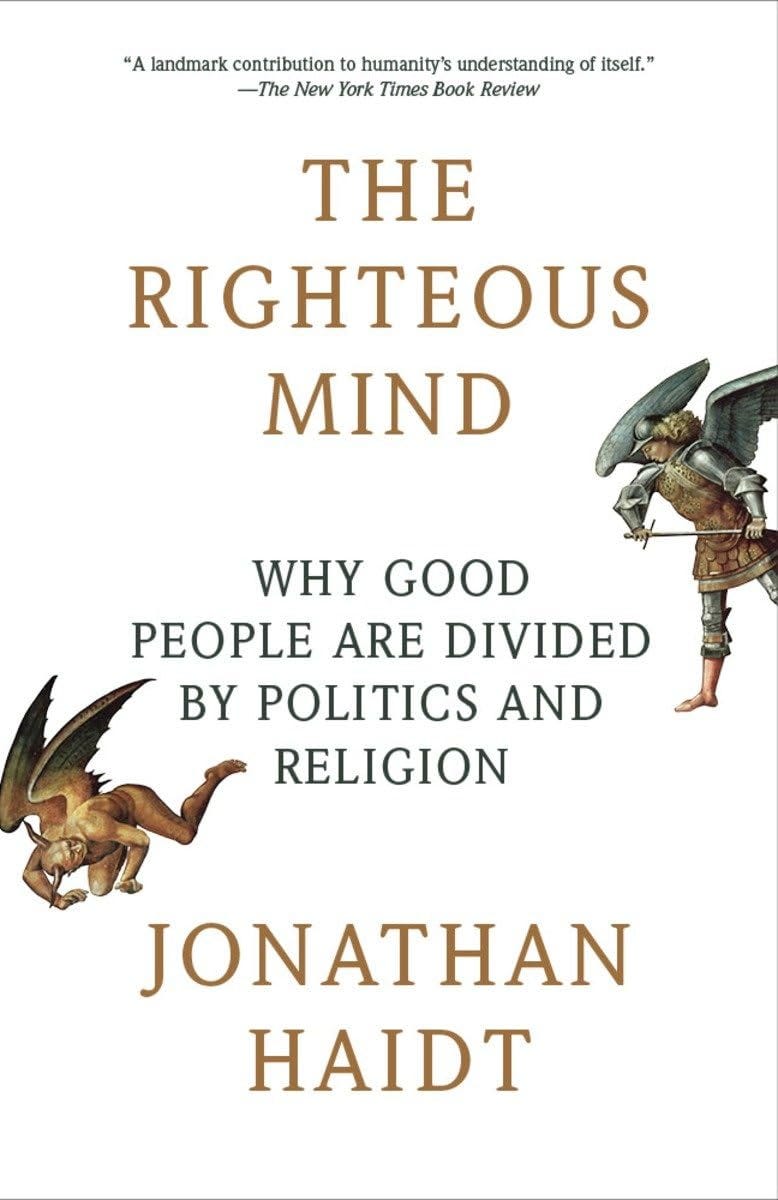
I just finished reading Jonathan Haidt’s The Righteous Mind: Why Good People Are Divided By Politics and Religion and while it was a very fascinating read, by the end of the book, it did begin to show its age.
In it, Haidt argues that our moral reasoning is built on several intuitive "moral foundations." He identifies six primary ones:
Care / Harm – Concern for the suffering of others; virtues like compassion, kindness, and protection of the vulnerable.
Fairness / Cheating – Justice, reciprocity, equality, proportionality, and opposing exploitation or dishonesty.
Loyalty / Betrayal – Commitment to one’s group, family, nation, or team; valuing solidarity and faithfulness.
Authority / Subversion – Respect for legitimate authority, tradition, hierarchy, and social order.
Sanctity / Degradation – Ideas of purity, holiness, and avoiding contamination, whether physical, moral, or spiritual.
Liberty / Oppression – Resistance to domination and coercion; valuing freedom, autonomy, and standing up to bullies.
His broader thesis is not that one side is morally superior, but that different communities “taste” morality differently. He likens morality to having several taste receptors: progressives tend to rely most heavily on Care and Fairness, while conservatives draw on all six foundations more evenly. That difference helps explain why people can look at the same issue and arrive at fundamentally different moral intuitions before they ever begin reasoning about it.
After finishing the book, though, it struck me that I don’t think it’s accurate to say progressives have abandoned loyalty, authority, or sanctity. Rather, I think they’ve relocated those foundations to different objects. Sanctity may be directed toward the environment, loyalty toward activist or moral communities, and authority toward marginalized voices or expert consensus rather than traditional institutions. That distinction turns out to matter quite a bit.
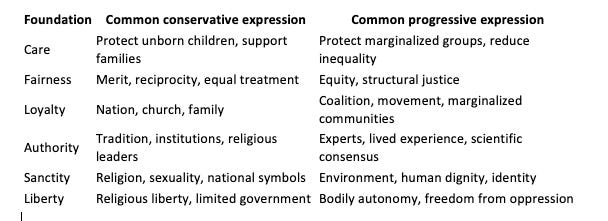
So while it’s possible that conservatives and progressives don’t weight each of these foundations equally, I think Haidt is at least partly wrong (and, from what I’ve read, he has since revised some of his thinking on this). Conservatives and progressives both appeal to all six foundations.
If that’s true, then the real takeaway is this: political opponents often aren’t speaking different moral languages—they’re using the same grammar but with different words.
The Same Moral Grammar, Different Words
I think that explains why debates so often feel like people are talking past one another. Each side hears the other saying, “You don’t care about equality,” when the disagreement is actually, “What counts as fair?” Or, “You don’t respect authority,” when the real question is, “Who has legitimate authority?”
To put it bluntly, each side has sacralized different things.
One of Haidt’s most helpful insights is that people often don’t disagree merely over facts—they disagree over moral framing. And once an issue is framed as a moral absolute, compromise becomes much harder because conceding feels like participating in evil.
Take abortion as an example:
Calling abortion “health care” frames it primarily through the moral foundations of care (meeting a medical need) and liberty (patient autonomy).
Calling abortion “the killing of an unborn child” frames it through care (protecting vulnerable life) and sanctity (the inviolability of human life).1
Neither phrase is morally neutral. Each foregrounds one moral narrative while backgrounding another. As a result, each can sound to the other side not merely inaccurate, but morally deceptive.
This phenomenon extends well beyond abortion:
“Gender-affirming care” vs. “gender ideology.”
“Tax relief” vs. “tax cuts for the wealthy.”
“Climate justice” vs. “energy independence.”
“School choice” vs. “defunding public education.”
These aren’t simply competing descriptions—they’re competing moral worlds.2
Why This Matters
Where things get especially tricky—and arguably even dangerous for the future of our nation—is this:
First, we no longer share a common moral language.
In the past, Christianity—or at least what many called “Judeo-Christian values”—functioned as a shared moral language that Americans could organize around. More broadly, the American mythos also offered a common vocabulary centered on ideas like independence, hard work, and personal responsibility.
Today, many rightly critique parts of that story, often in favor of multiculturalism and pluralism. But I think we also have to name the elephant in the room: increasingly, we no longer share a common moral foundation or even a common moral language. We’re using the same words, but we mean very different things by them.3
Second, moralizing immediately raises the stakes.
Some issues do this more than others. “Tax relief” versus “tax cuts for the wealthy” doesn’t carry the same moral weight as framing abortion as either women’s autonomy or the killing of an unborn child.
But more and more issues are becoming moralized. Take the debate over trans kids. Both those who affirm gender transitions and those who oppose them generally believe they are protecting trans children (I’ve written about this in a previous Substack). Once an issue becomes morally foundational, disagreement is no longer experienced simply as someone holding a different opinion. It becomes an attack on one’s deepest moral commitments—and often on one’s identity.
Third, moralizing makes disagreement feel morally unacceptable.
In many ways, moralizing allows us to build a proverbial ivory tower while making ourselves almost impervious to questioning or debate. “How dare you?” becomes the default response.
Growing up in a very conservative environment, abortion simply wasn’t debatable because of how it was framed. If abortion is murder, how can we possibly negotiate over the taking of innocent life?
A similar dynamic exists on environmental issues, though with different moral foundations. Many progressives understand the earth as something sacred. Conservatives are more likely to understand nature primarily as a resource for human flourishing. Think of the Dakota Access Pipeline protests. “Water is Life” wasn’t merely a slogan; it framed water as something sacred.4 That framing often made little sense to conservatives, who were more likely to view both water and oil as resources to be stewarded for humanity’s flourishing (which, in turn, many conservatives regard as sacred beneath God).
Once something has been sacralized, compromise becomes extraordinarily difficult. You’re no longer negotiating policy. You’re negotiating morality itself.
So what do we do instead?
Three things come to mind.
First, delay moral absolutizing.
Whenever possible, we should describe an issue in ways that both sides could at least recognize as fair before moving to moral evaluation.
Unfortunately, our social media ecosystem rewards the opposite. Algorithms reward immediate moral framing because outrage drives clicks—for supporters and detractors alike. And the quicker we’re able to moralize an issue, the quicker we convince ourselves we’ve gained the moral high ground, whether fairly or not. This is why nearly every tragedy is moralized almost immediately.
Second, learn to separate our moral beliefs from ourselves.
Here’s what I mean.
In modern Western culture, the individual has increasingly become the primary moral authority. In earlier eras, the family, tribe, or religious community often functioned as that center instead. Of course, those arrangements had plenty of their own problems—people fought when their family, tribe, or religious community was threatened.
But today, criticism of our moral beliefs is often experienced as criticism of us.
I wonder if we’d be healthier if we were more intentional about locating our moral beliefs outside ourselves. For Christians, for example, our moral framework ought to be grounded in Christ and the Christian tradition, not simply in our individual preferences. More broadly, simply naming where our moral convictions come from may help create a little distance between ourselves and our beliefs. Then, when someone challenges those beliefs, they’re not rejecting me as much as they’re engaging a set of convictions that I hold.
Third, become more secure in what we actually believe.
This may sound counterintuitive, but I sometimes wonder whether our outrage stems less from deep conviction than from shallow formation.
We often assume people are deeply knowledgeable about the beliefs they hold most passionately. I’m not convinced that’s true. Because we don’t always understand why we believe what we believe, criticism feels disruptive—even dangerous.
But if I know my own convictions well, I can receive critique without immediately feeling threatened. I can weigh it against my own reasoning, acknowledge where it exposes weaknesses in my thinking, and explain why I ultimately agree or disagree.
Ironically, the more secure we become in our own beliefs, the less threatened we become by someone else’s.
In closing
None of this means moral truth doesn't exist or that every viewpoint is equally valid. It does mean, however, that if we hope to persuade rather than simply condemn one another, we have to understand the moral world the other person is inhabiting.
We don't heal polarization by shouting our sacred values louder.5
We begin by recognizing that, more often than not, we're arguing over different sacred objects while using many of the same moral instincts. That recognition won't solve our disagreements, but it might make genuine conversation possible again.
The abortion debate strikes me as especially frustrating and counter-productive. Meaning, ONLY VERY SMALL segments of society think women should have no personal autonomy or that abortion should be legal no matter the point in pregnancy. Instead, the VAST MAJORITY recognize there is some nuance or complexity. What if, instead of moral absolutizing, we could instead talk about shared moral values on these topics?
The point of this blog isn’t to argue for which moral argument is right or wrong.
Frankly it would be nice if there WAS some agreed upon moral framework, even if other than Christianity, besides “you do you,” which quite obviously works up until “you do you” starts to impact me.
I understand the in many ways, water is quite fundamentally necessary for life. I’m not trying to question or debate the relevance or value of individual moral claims, rather make the point that when claims come from a different moral framework, they won’t make any sense to those operating from within a different framework or perspective.
I also want to acknowledge that in this instance, the issue was very complex, touching on the autonomy of Indigenous communities, the care and protection of their land and drinking water sources, and more. I’m not trying to diminish that.
What I am trying to wonder, and I may be wrong on this, is whether seeking more consensus-based, universal appeals would resonate better than morality-based appeals?
I think most moral appeals these days are essential appeals to emotion, which I also don’t think is effective.