


TL;DR
Mainline churches grew by going where people were—once rural America. But as populations shifted to cities and suburbs, many denominations failed to follow. The result: underrepresentation in population-dense areas, continued decline, and missed opportunities. The challenge now isn’t just survival—it’s whether churches will realign resources to reach people where they actually live today.
Mainline Churches Aren’t Where the People Are
What if the biggest problem facing Mainline churches isn’t theology, attendance, or even leadership—but geography?
What if, quite simply, we’re not where the people are anymore?
I really need to write something up about Andrew Root’s new book Baal and the gods of More plus of course my podcast partner Martha Tatarnic’s new release on Anne Boleyn: Reputation, Revolution, Religion, and the Queen who Changed History.
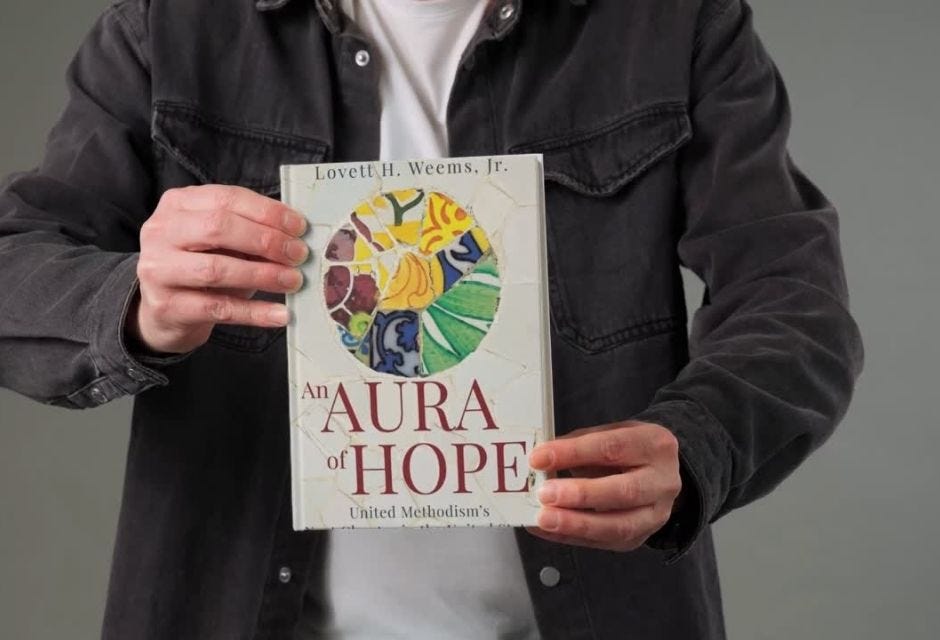
But in the meantime, I just finished a short but important book from United Methodist leader Lovett Weems that’s worth highlighting:
An Aura of Hope: United Methodism’s Next Chapter in the United States.
I won’t get into the whole book here—I have an interview scheduled with him for the Future Christian podcast—but there was one piece of data that stuck with me.1
How Methodism Grew (and Why That Matters)
Weems notes that part of what fueled early Methodist growth in America was Francis Asbury’s commitment to send preachers to where people actually were.
At the time, that meant rural America.
Which is why, to this day, you see Methodist churches scattered across small towns all over the country.
But here’s the problem:
The population has shifted.
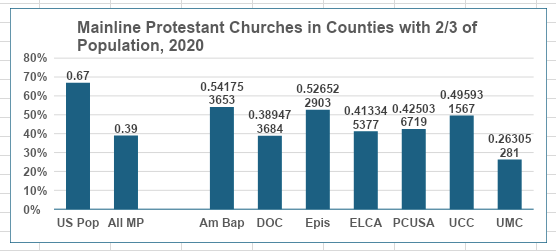
And now, the counties where two-thirds of Americans live have the fewest United Methodist churches.
A Problem Bigger Than One Denomination
This hits close to home for me.
Right now, I’m living in two worlds—attending a UMC church, but ordained in and still very connected to the Christian Church (Disciples of Christ).
And as the data shows, the Disciples aren’t far behind. We’re also underrepresented in high-population areas.
Which makes sense historically. Like Methodists, Restoration Movement2 churches were highly evangelistic—planting churches where people were at the time: rural communities.
The problem is, we haven’t followed people as they’ve moved.
Why This Matters
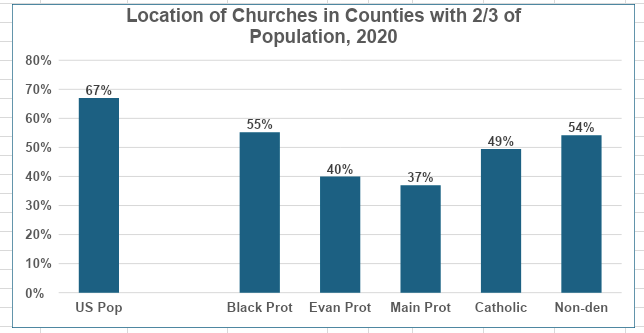
Looking at Weems’ data, it’s not surprising that Mainline Protestantism has struggled while non-denominational churches have held steady or grown.
Outside of Black Protestant churches, non-denoms are most widely represented in population-dense counties.
That’s where the people are.
And as Weems puts it:
“from the 1970s onward, the misalignment of denominational efforts with the new demographic realities led to immediate and continuing decline.”3
In other words, we’re not where we need to be.
UMC churches, he notes, are “least represented among the populations we most seek to reach.”
A Hard but Practical Solution
So what can be done?
Weems’ answer is pretty straightforward: reallocate resources.
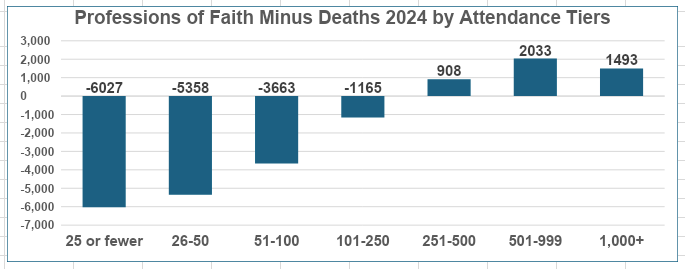
That likely means fewer resources going to struggling churches—and more investment in larger churches located in population-dense areas.
That’s not a new idea.
What’s compelling is the data behind it: larger churches are simply more likely to reach more people.
If we’re serious about engaging unchurched communities, we have to think strategically about where and how we invest.
And this isn’t just about growing white, suburban churches.
Those same population-dense areas are also where younger and more diverse populations live.
The Reality Check
Of course, this is much easier said than done.
It’s likely more feasible in a connectional system like the UMC than in a congregational one like the Disciples of Christ.
And none of this is to say small-town churches can’t be vital.
Last summer I heard from someone at a small DOC church in tiny Frankford, Missouri—stories of baptisms, growing children’s ministry, and real community impact.
Those stories matter.
But the broader reality still holds.
As Ryan Burge has pointed out elsewhere: if we could take all those rural church buildings and drop them into major cities, we probably would.
Of course, we can’t.
So the question becomes: what can we do?
Two Takeaways
First, Mainline leaders should give ourselves some grace.
A significant portion of Mainline decline is tied to demographic shifts outside our control.
But second—and this is harder—we’ve done a poor job adapting to those shifts.
As Burge and others have shown, moving is one of the biggest factors in people leaving church.
And when they finally consider returning to church in their new community…
What do they find?
Non-denominational churches.
Not Mainline ones.
Final Thought
For anyone who cares about the future of the UMC—or the Mainline more broadly—Weems’ book is worth your time.
Because this isn’t just about decline.
It’s about alignment.
Methodism (and the Restoration movement) grew because it went where people were. The question now is whether the Mainline is willing to do the same again.
Not in theory.
In practice.
And thanks to Lovett Weems for sending me the Excel spreadsheets for his data!
The Restoration Movement, sometimes called the Stone-Campbell Movement, is a term for the revival movement that formed in the early 19th-century America and from which came the Churches of Christ, the Disciples of Christ, and independent Christian Churches.
I’d be curious if denominational historians have thoughts to share on church-planting efforts in growing cities post-1970s. In the Denver-metro where I live, by-and-large, at least among the DOC and UCC which I’ve most closely looked into, church planting basically stopped—or at least few plants (including my own) actually stuck.
In my denomination there are two churches in my community but the big churches are still non denominational (which means they are either SBC or AG, usually). So we ARE there. But of course we’re not everywhere. Non denominational churches don’t deal with denominational structures which sometimes get in the way of adaptation. As well, I think there is an issue where people think that denominational identity is a drawback, and believe that somehow the nondenominational churches are more authentic because they aren’t hawking a certain perspective.
It's not for nothing that some of the fastest-growing churches in the DOC are in thriving urban/suburban areas (I'm thinking like Woodmont in Nashville and Harvard Ave. in Tulsa). I've also noticed some churches in smaller areas doing exceptionally well (like FCC in Great Bend, KS), the common denominator being that growing churches have updated their structure and adopted a more mission-driven approach. (Insert caveat here about the importance of small churches and that not every church has to be big).
A lot of congregations with dynamic, compelling theology are still using a structure from the 1950s. Jeff Gill has written about the "Functional Church Organization" that was heavily promoted in the post-war era. I wish denominational leaders would make a similar push today.
I guess my point here is that Disciples are REALLY bad at being strategic.
I hear claims sometimes about how we reached our goal to start 1,000 new churches by 2020. It takes about 30 seconds in ALEX to figure out that most of those churches didn't survive. Many that did weren't even started by us, but were rather churches started by others that chose to affiliate with the Disciples. Honestly, I see that as one of our greatest strengths. We're bad at raising up church planters, but great at welcoming new churches looking for a home.
A related point...I could imagine the very concept of deploying resources more strategically getting a frosty reception from many corners of the DOC.