


Ryan Burge is perhaps the leading sociologist of religion in America,1 so whenever he says something, I pay attention—including if that means finding him and listening in unorthodox places, such as a Southern Baptist podcast, Rainer on Leadership. In a recent episode, Burge talked about the positive impact church attendance has on mental health and the fabric of American society.
Most interesting to me, however, was how some of the very things he highlights about the good of church are key parts of many Mainline churches and should offer us in the Mainline world a ray of hope. Burge makes a compelling case that churches provide critical social infrastructure. Beyond worship, they are places where people build relationships, find meaning, and receive support in times of crisis. He notes:
“I think we're going to see more and more people realize that they didn't understand the full flower of what religion does in American society until it's gone… The after-school program goes away, the weekend feeding program goes away… Alcoholics Anonymous meets in the church gymnasium once a week. Where are they going to meet?”
This statement struck me because many Mainline churches are already doing these things. The very aspects of church life that Burge says people will eventually miss are the bread and butter of many Mainline congregations today.
Could This Lead to a Mainline Rejuvenation?
Burge suggests that if people begin to recognize what they are losing when churches decline, we could see an unexpected resurgence of church attendance—not necessarily in the form of massive revival meetings, but in a slow and steady return as people seek out the benefits churches uniquely provide. He states:
“If that happens, I think we might see a religious revival, which might not be the revival that like a lot of classic evangelicals think about, where hundreds of people come down for the altar call. But the pews might start looking a little fuller on a Sunday morning.”
For those of us in Mainline churches, this should be an encouraging word. It suggests that our work—whether in food ministries, social justice efforts, or simply providing a place for people to belong—could be precisely what draws people back. If we remain faithful to our calling, our churches may not just survive, but thrive.
Why Church Buildings Still Matter
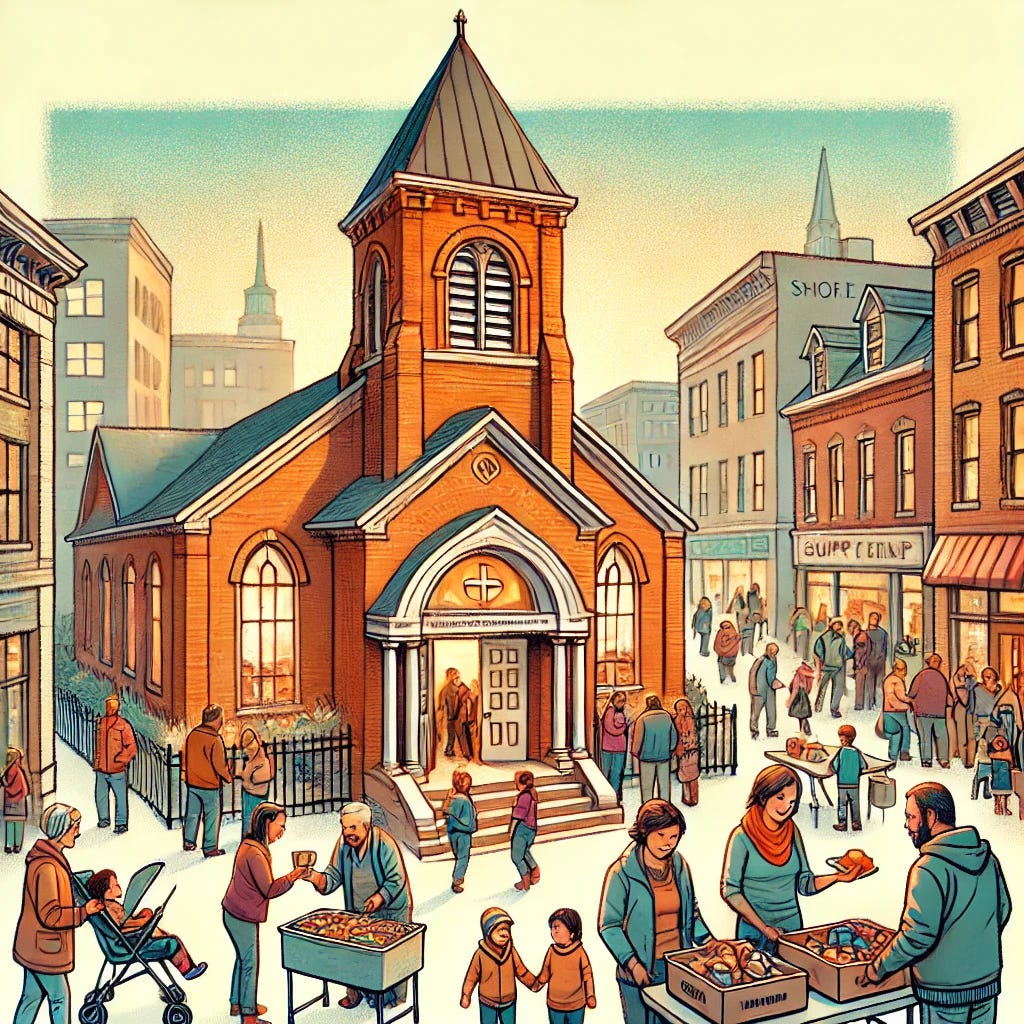
For this renewal to take place, however, churches need more than just a mission—they need a place to carry it out. Too often, struggling congregations are quick to sell their buildings, assuming that property is a burden rather than an asset. But if Burge is right about what churches offer, then our buildings play a critical role.
Churches are not just places of worship; they are physical spaces where community happens. Without them, the vital ministries Burge describes—feeding programs, support groups, places of refuge—become much harder to sustain. As he warns:
“These are problems that will only become problems when the churches go away and there’s no one to fill the gap.”
This does not mean churches should hold onto massive, underused spaces out of sheer nostalgia. But it does mean that when considering a future without a building, congregations should ask: What impact will this have on our ability to serve? Selling a church building might relieve financial pressure in the short term, but it could also sever a congregation’s ability to be a meaningful presence in the community.
A Challenge and an Opportunity
Burge’s insights should push us in the Mainline world to both gratitude and action. Gratitude, because many of our churches are already doing the very work he describes as essential. Action, because we need to lean into this role even more, recognizing that we have something invaluable to offer.
If we believe Burge is right, then we have every reason to double down on community engagement, to fight for the spaces that allow us to serve, and to trust that, even in an era of religious decline, our churches still have an essential role to play.
Reclaiming Sacred Spaces: Why Mainline Churches Should Keep Their Buildings

The Growing Trend of Mainline Churches Selling Their Buildings
The Contradiction in Church Architecture

Can you imagine giving a presentation on healthy eating in the middle of a candy shop?
I love this article. Do you know about bricks and mortals or my book remove the pews. Let’s talk about this work and you. Revdschaper@gmail or 413 687 1937
I 100% believe you are right, and have been trying to push the same message. In many places, our steady, boring witness and theology is...exactly what is needed, right now.
Some of us are embedded in neighborhoods and know a lot of about what it means to built community.