


TL;DR:
Many progressive responses to Trumpism rely on reaction and emotion rather than a coherent moral vision. Drawing on Tim Keller and Justin Giboney, this post argues that real moral imagination can only grow out of a rooted moral ecology—one grounded in truth, community, and conviction rather than shifting feelings or cultural vibes.
When the Vibes Shift, What Holds?
I’ve been thinking a lot lately about how wildly out of touch parts of the progressive left seem to be with large swaths of American society—and how many of their proposed “solutions” to Trumpism amount to little more than swinging the pendulum hard in the opposite direction. The goal often appears less about articulating a compelling moral vision and more about undoing whatever Trump did, rather than offering policies and practices capable of shaping a kinder and more generous society.
What strikes me is that this isn’t just a political failure; it’s a moral one. Reaction can feel satisfying in the moment, but it doesn’t actually form character. And when the emotional energy runs out—or the vibes shift—it leaves very little behind to sustain people.
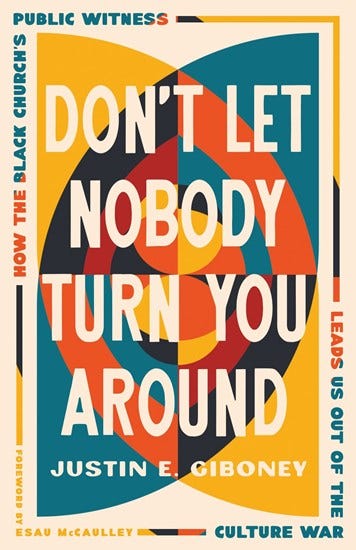
That question—what actually forms people morally over time—is what brings me back to the idea of moral ecology, and more recently, to the concept of moral imagination as discussed by Justin Giboney is his book Don’t Let Nobody Turn You Around.
In a past post, I wrote about how the Anglican tradition forms a moral ecology. Here’s the key point I’m drawing from that work.

In his book How to Reach the West, Tim Keller writes that character isn’t taught in a classroom but lived in community. He breaks down a moral ecology by explaining that it answers five basic questions:
Why be good?
What specifically is good?
What is not good?
Who is good? (imagination)
How can we be good in daily life?
For this post, I want to explore how a moral ecology gives rise to a moral imagination, working largely from Justin Giboney’s book.
Giboney defines moral imagination this way:
“Moral imagination is the ability to see not simply what has been historically, what is in the present moment, or what’s likely to be in the future. It’s the ability to see what ought to be and what will be based on God’s capacity, character, and promises” (156).
He expands on this definition by noting that moral imagination is faith applied to what we see as possible in our daily lives, and that it should shape our public witness. More than that, it becomes the frame through which we evaluate circumstances and pursue solutions. What I think is especially important is his claim that moral imagination is “how we know wicked systems can be overcome, anyone can be forgiven and redeemed, and biblical truth is still truth” (162).
A simple way I’ve come to think about the difference between these two ideas is this:
Moral ecology answers what should be.
Moral imagination asks what could be.
Keller seems to suggest that imagination is part of a moral ecology, and I think that’s mostly right. But following Giboney, I’d argue that moral imagination actually stems from a moral ecology; it doesn’t arise on its own.
Giboney points to the Black Church as a particularly instructive example here, noting that its social action tradition is distinctive precisely because it exemplifies moral imagination, especially in transcending today’s culture-war mentality (171). He’s careful to add that this moral vision is rooted in Christian orthodoxy. I was reminded of Walter Strickland’s Swing Low, where he makes a similar argument, writing that “the roots of African American Christianity are unmistakably evangelical, and orthodox doctrine has flourished outside white evangelical denominations and institutions” (205).
The takeaway for me is fairly straightforward: a moral imagination must be rooted and grounded in a solid moral ecology.
A second, related observation from Giboney is his assertion that “reason and emotion alone can’t apprehend the gospel ethic” (156). In other words, as I understand it, reason and emotion by themselves are not sufficient foundations for a moral ecology.
To illustrate this, Giboney points to how despair and cynicism have begun to overrun parts of American society, especially on the progressive left. He writes that “despair… has caused some to fetishize oppression,” assigning moral status based on accumulated markers of marginalization. Ironically, he argues, reveling in marginalization is often a display of privilege—only those with certain advantages have the space to be performative about real struggle (161).
The short of it is this: the progressive left has insisted that there are no foundational truths or metanarratives, nor are they necessary for pursuing goodness or justice. Yet over the past few years, the opposite seems to have been revealed. Much of the modern left has moved away from reason and leaned heavily into emotion. Reading Susan Neiman’s Left Is Not Woke, I was struck by how thoroughly reason has been sidelined in favor of feeling.
The problem with feelings, of course, is that they shift. What happens, as Giboney suggests, is a kind of nihilism. A good example of this was the “Dark Brandon” meme trend that circulated a year or two ago. It began as ironic political humor but evolved into something broader—a celebration of cruelty, mockery, and dominance framed as moral righteousness. My point isn’t about the meme itself; it’s that when there’s no moral foundation, emotion becomes all we have.
Again, as Giboney highlights the Black Church as a moral example, it’s worth remembering that the Civil Rights movement faced countless setbacks and obstacles—and arguably still does. What sustained many of its leaders was a refusal to give in to reactive anger or despair. The movement was grounded not in emotion but in moral conviction rooted in God and Scripture. As Martin Luther King Jr. said explicitly in Letter from Birmingham Jail, “there are just laws and there are unjust laws…A just law is a man-made code that squares with the moral law or law of God.”
Similarly, in this critique of the white American church, the standard he held them to was not his own or cultural vibes—rather, he continually lashed out at the church for failing to live up to its foundational values—demanding the church not be “merely a thermometer… of popular opinion” and instead for it to recapture it’s “sacrificial spirit.”
To sum this up, what I appreciated most about Giboney’s book is the reminder that moral imagination can only grow out of a moral ecology—specifically one grounded in truth and conviction. A foundational flaw of the progressive left is the assumption that all truths are equal. But when the rubber meets the road, challenges arise, and the vibes shift, what’s going to sustain someone is not emotion but rather morally grounded truth.
I love this. This is a beautiful way to discuss path 3 of Creation Spirituality, which is where I have been spending so much of my time taking about lately. I love the language and imagery. It is so helpful to form is into the people we are called to be and not just suffer at the whims of our feelings and the news.