


Western civilization stands on the cusp of a spiritual revival—but not the kind we might expect. Having tried and failed to save itself through reason, activism, and self-reliance, society now finds itself mired in deep sadness and despair. In this longing for transcendence, many are turning not to traditional sources of faith, but toward darker forms of re-enchantment—occultism, techno-mysticism, and counterfeit spiritualities. While Mainline Protestantism holds a rich heritage of wisdom, tradition, and spirituality, it is often overlooked because Progressive churches have largely reduced the faith to Moralistic Therapeutic Deism—offering little in the way of true spiritual power or mystery. The only hope for both Western civilization and the future of the Mainline Church is to reclaim a vibrant, supernatural faith—rooted in the Resurrection, saturated with Mystery, and anchored in enduring Hope.
This reflection began after listening to two separate podcast conversations—one featuring Mark Sayers on the Carey Nieuwhof Leadership Podcast, and another with Rod Dreher on Mother, Maiden, Matriarch. Both episodes, though vastly different in tone and context, pointed to the same unsettling reality: we are living in a moment where spiritual hunger is growing—but instead of returning to the Church, many are seeking transcendence in darker, more dangerous places. Their insights sparked an idea—that Western civilization isn’t just disenchanted; it’s being re-enchanted in ways the Church seems unprepared to address.
Introduction
Since the Enlightenment, Western society has followed a path away from mystery—embracing reason, science, and social progress as substitutes for faith. Especially among Progressives, there’s been a persistent belief that, with enough effort and activism, we could build a better world without the need for God. Yet the opposite has unfolded. Rather than achieving utopia, we find ourselves slipping into what some call a soft despotism, marked by growing anxiety, isolation, and despair.
In this spiritual vacuum, people are once again searching for transcendence—but not in churches. As Andrew Root observes, there’s a growing awareness that we need something "beyond." Mark Sayers calls it a “spiritual awakening,” though it’s manifesting in unexpected places—podcasts on psychedelics, Silicon Valley séances, and UFO hearings. Rod Dreher warns that this is no benign revival, but a “dark re-enchantment” fueled by occultism, AI mysticism, and techno-spirituality.
We are entering an age of re-enchantment—the only question is what kind of enchantment will shape us.
And tragically, much of the Progressive Mainline Church has little to offer this moment, having abandoned its supernatural core—starting with the resurrection itself. As Root notes, “Ironically, just when most mainline church leaders—sick of feeling embarrassed and cross-pressured with an uneasy doubt—stopped talking about transformation, others in our secular age began talking about it.”
I. False Paths to Transcendence: Secular Mysticism
In The Church in an Age of Secular Mysticism, Andrew Root outlines three modern pathways people pursue in search of transcendence or transformation. The first is what he calls “Counter-Enlightenment”—the belief that transformation comes through external, heroic action. Think fitness journeys, radical life overhauls, or epic quests for purpose. The second is the “Exclusive Humanist” path, where transformation is sought through inner work and self-discovery—captured in phrases like “doing your own work” or “finding your truth.” Root contrasts these with a third, deeper way—the path of the “Beyonders”—those who discover true transformation through surrender and confession.
What’s striking is how these first two paths mirror today’s cultural and political divide. The Counter-Enlightenment impulse is particularly visible on the political right. Among men, there's a growing obsession with being "Alpha"—reasserting authority through strength, bravado, and dominance. For women in these circles, there's often a return to idealized traditional roles—the rise of the "trad wife" phenomenon, curated for public display across Instagram and social media.
On the political left, the Exclusive Humanist path dominates—an endless cycle of self-refinement aimed at rooting out bias, privilege, or internalized injustice. It's built on the conviction that if individuals can perfect themselves, they can then perfect society—creating just systems through personal moral evolution.
The problem, as Root argues, is that both paths lead to the same dead end: frustration, disillusionment, and a profound lack of real transformation.
Those on the Counter-Enlightenment track increasingly turn toward what Root and others describe as soft despotism—recognizing that personal bravado isn’t enough to shape society, they resort to force, control, and suppression of opposing views. It's no longer about influence; it's about eliminating dissent—whether that’s DEI initiatives, CRT, or anything perceived as a threat to their vision.
Meanwhile, on the Exclusive Humanist side, the futility of endless self-reform is breeding deep disappointment and creeping nihilism. The mental health crisis among young progressives—especially women—is well-documented (see Jonathan Haidt). Many young men, disillusioned by the unattainable ideals of constant self-purification, are abandoning this project entirely—some retreating into “incel” culture, others embracing more openly toxic or hyper-traditional forms of masculinity. Whether through resentment-fueled online communities or reactionary calls to restore rigid gender roles, these are symptoms of a deeper disillusionment—a generation of young men rejecting the unattainable ideals of self-reform, but finding no healthier vision of identity or purpose in its place.
In both cases, the pursuit of self-made transformation has collapsed into sorrow. A great sadness hangs over a generation that believed it could save itself—and is now realizing it cannot.
II. Despair and Great Sadness: When Secular Mysticism Collapses
In Evangelism in an Age of Despair, Andrew Root argues that we’ve become a society so obsessed with pursuing happiness that it’s actually making us sad. He writes that “we are uncomfortable with the very fact that sorrow is unavoidable for us all.” As much as I admire Root’s work—nine books in—I can’t help but feel that reality has already moved beyond his pages. Not by fault of his insights, but simply because academic work lags behind lived experience.
Western civilization—especially its younger generations—is no longer just chasing happiness and coming up short. It’s steeped in despair. While some still numb the ache with fleeting pleasures, many have simply given in to the doom.
Social psychologist Jonathan Haidt gives language—and data—to this phenomenon. In progressive spaces, particularly online, despair has shifted from private struggle to public identity. Young progressives, especially girls, are immersed in digital cultures that reward vulnerability, amplify outrage, and normalize pessimism. Haidt writes, “Progressive teens—especially girls—are immersed in a digital environment that trains them to catastrophize, to see the world as hostile, and to believe that despair is the rational response.”

With religion and transcendence stripped away, nothing remains to offer resilience. In such a world, doom becomes a virtue—proof that you’re awake to how broken everything really is.
But despair isn’t confined to progressive spaces. As Mark Sayers notes, young conservatives face a quieter, but equally corrosive, burden: economic hopelessness. The promises of previous generations—home ownership, stability, upward mobility—feel permanently out of reach.
“You’ve got a young generation who has no hope for the future... The social contract for them is broken.”
This isn’t loud protest—it’s silent resignation: “I’m never going to get ahead.” Sayers warns of a drift into techno-feudalism, where ownership disappears, and life becomes a cycle of endless renting—whether it’s housing, careers, or digital existence.
“We’re heading into a kind of techno-feudalism... You’ll own nothing, and everything will be rented.”
This loss of agency breeds cynicism and a hunger for control—or at least for someone who will seize it on their behalf.
Here’s where Root’s observation about soft despotism becomes painfully clear. When people believe the system is rigged, many turn to strongmen who promise to fight back—regardless of method or morality. “If I can’t win fairly, I’ll back someone who breaks the rules for me.” This isn’t ideology. It’s survival instinct driven by despair. When hope fades, people stop caring how salvation comes—only that someone promises to deliver it.
In this landscape—whether shaped by cultural doom, economic fatalism, or authoritarian temptation—one truth remains: people know they need more. Beneath the cynicism is an unspoken awareness that politics, progress, and power cannot satisfy the deeper hunger for meaning, mystery, and transcendence.
At first glance, this spiritual longing might seem like a golden opportunity for the Church. But the problem is clear: people aren’t turning to traditional faith. Instead, they’re reaching for spiritualities that promise transcendence—without surrender. Mystery—without hope. And increasingly, those paths are leading into far darker territories.
III. The Turn to Dark Re-Enchantment: Seeking Transcendence in Counterfeits
Listening to Mark Sayers, I was struck by how he framed UFOs, psychedelics, and spiritual openness—not as fringe curiosities, but as signs of a growing spiritual hunger within Western culture. What once belonged to conspiracy theories or countercultural movements is now mainstream—whether it’s Silicon Valley elites microdosing for enlightenment or Senate hearings discussing unidentified aerial phenomena.
That realization hit even harder when I stumbled upon another conversation—this time between UK journalist Louise Perry and American writer Rod Dreher, now living in Hungary. Here were two separate discussions—one hosted by a Canadian (Carey Nieuwhof) interviewing an Australian (Sayers), the other connecting voices from the UK and the US. Between them, nearly the entirety of Western civilization was represented—and they were all observing the same unsettling reality:
People are spiritually hungry, but instead of returning to the Church or historic faith, they are seeking fulfillment in darker, more dangerous forms of transcendence.
Dreher describes a world where UFO culture has morphed into an emerging religion, with influential figures treating interdimensional encounters as pathways to higher knowledge. He warns that many no longer seek God but are instead summoning orbs, channeling “higher intelligences,” and embracing AI as a kind of high-tech Ouija board. As Dreher puts it, “We can’t talk about positive enchantment without also talking about dark enchantment—of the occult, technology, psychedelic drugs, and this emerging cult of UFOs.”
From opposite sides of the globe, both Sayers and Dreher are witnessing the same phenomenon: a disenchanted world rediscovering the supernatural—but not through the Church. Instead, people are reaching for mystery in places that offer experience without surrender, transcendence without hope, and power without redemption. It’s re-enchantment—but shadowed by danger.
Part of the allure, as Dreher points out, is that these spiritualities promise mystery without submission. The rise of occult practices offers empowerment and control—connection to something beyond, but without repentance or obedience. “The occult gives people the sense that they can engage with the spiritual realm on their own terms.” Silicon Valley’s fascination with AI-driven transcendence bypasses divine encounter altogether, while psychedelics offer instant spiritual highs—visions without vocation, ecstasy without enduring hope.
This is the shape of re-enchantment in our age: a hunger for the supernatural, stripped of covenant, accountability, and the redemptive story of God. It’s spirituality crafted for a culture that craves mystery—but not a Lord.
This trajectory aligns perfectly with Andrew Root’s critique in Church in an Age of Secular Mysticism. True transformation, Root argues, comes through confession and surrender—but modern seekers instinctively resist both. After all, admitting that the self is neither unique nor magnificent runs counter to everything contemporary culture preaches. Yet beneath that resistance lingers a quiet unease: despite every attempt to summon transcendence on their own terms, people cannot save themselves.
And this is where the tragedy deepens. In an age starving for mystery, transcendence, and genuine encounter with the divine, the Church should stand as a beacon. But much of the Progressive Mainline has abandoned the very elements seekers crave. Instead of offering a faith where God acts, speaks, and transforms, it has recast God as a distant ideal or a cheerleader for human activism. Transcendence has been traded for relevance. Mystery flattened into metaphor. The result? A faith rooted in human effort—one that inspires but does not intervene.
In a world desperate for the sacred, too many churches echo secular hopes when they should be proclaiming divine power.
IV. The Progressive Church’s Blind Spot: Disenchanted Faith in a Re-Enchanting Age
In many ways, this cultural moment should represent an incredible opportunity for growth and renewal within Mainline churches. These congregations offer an open and inclusive faith—appealing to those on the political left—while also holding deep wells of history, tradition, and liturgy that could resonate with those drawn to Counter-Enlightenment ideals on the right.
But here’s the tragedy: in many contexts—especially within Progressive circles—the Church has largely abandoned the belief that Christianity offers anything truly supernatural or transcendent. The faith has been reimagined as a wholly this-worldly project—a vehicle for ethical living, social justice, and community belonging, but little more.
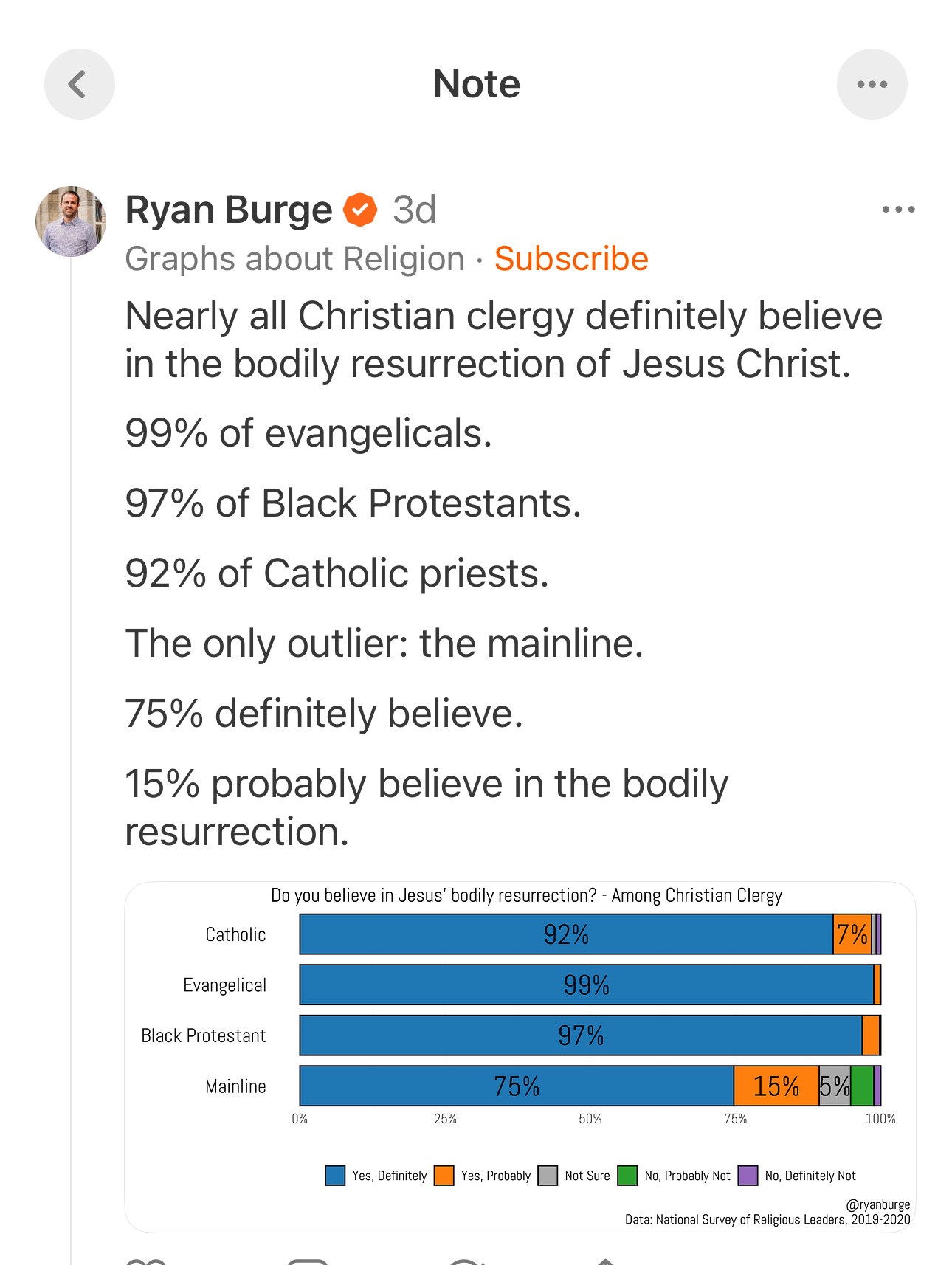
A friend recently sent me a graph from Ryan Burge, showing that only 75% of Mainline clergy affirm belief in the bodily resurrection of Jesus—the lowest among Christian traditions. Honestly, I was surprised it was that high. After two decades of Easter services in Mainline churches, I’ve heard far more pastors hedge or reduce the resurrection to metaphor than proclaim it as historical and supernatural reality.
Now, to be clear, I’m not suggesting that belief in a physical resurrection is some simplistic litmus test—or that faith should be reduced to rigid doctrinal assent. If I’m honest, ask me every day for a month, and I might give a different answer depending on my mood or my doubts. But that’s precisely why mystery matters. Christianity was never meant to be a system we intellectually master or a set of moral values we perform. It’s a story we’re invited to inhabit—a story where the supernatural breaks in, even when we can’t fully explain it.
The danger isn’t doubt. The danger is when churches abandon transcendence altogether—when mystery, miracles, and divine intervention are dismissed as outdated. That’s when Christianity collapses into little more than Moralistic Therapeutic Deism: a system where God is distant, faith is about being nice, and salvation is replaced by activism.
Within much of Progressive Mainline Christianity, there’s simply no “there” there. Everything depends on our efforts alone—and in a world already crushed by self-reliance, that’s not just insufficient.
It’s soul-crushing.
When God becomes little more than a moral example or a cosmic cheerleader, the weight of personal and societal salvation falls entirely on human shoulders. As the Apostle Paul warned:
“If in Christ we have hope in this life only, we are of all people most to be pitied.” (1 Corinthians 15:19)
Without resurrection hope—without assurance that a power beyond us is at work for us—we are, quite literally, most miserable. The despair, exhaustion, and frantic search for meaning in counterfeit spiritualities today bears witness to that truth.
Is it any wonder, then, that people—crushed by the burden of self-salvation—are reaching for anything that promises transcendence without surrender? When the Church offers no mystery, no intervention, no supernatural hope, people will turn elsewhere. They will seek visions without vocation, ecstasy without sacrifice, and power without grace.
The great irony is that, in a world desperate for mystery and meaning, much of the Church has chosen to offer little more than moral encouragement and human-centered activism. But a faith drained of transcendence cannot sustain weary souls—or withstand the pull of darker spiritualities.
If the Church hopes to speak into this age of despair and counterfeit enchantment, it must recover what makes Christianity more than just another ethical system. It must remember that at the heart of the gospel is not advice or activism, but an announcement:
Christ is risen.
V. The Call to True Re-Enchantment: Resurrection, Mystery, and Hope
One of the most profound insights from Andrew Root is his assertion that when we step into the sorrow of another, God shows up—in mysterious and holy ways. Root writes, “Evangelism, if we can see it through consolation as sacramental, invites others to receive a blessing... God enters all sorrows for the sake of redemption and participation in God’s infinite life.”
As someone who has served as a chaplain, I know firsthand how true this is. I don’t do this work for the low pay, unpredictable hours, or the occasional puzzled look from hospital staff. I do it because I’ve encountered something strange, holy, and utterly unexplainable. In those raw, unscripted moments of standing beside people in pain, loss, and uncertainty, mystery becomes tangible. Consolation becomes a kind of sacrament. The presence of God isn’t theoretical—it’s real.
This is what the Church has forgotten.
If Christianity—especially within Mainline Protestantism—is to find renewal in this age of despair and dark re-enchantment, it must reclaim its supernatural core: resurrection, sacraments, and divine encounter. This will be especially challenging for traditions shaped by a skepticism of mystery—where practices like the Eucharist have been reduced to mere remembrance, stripped of presence and power.
As Mark Sayers rightly says, “People want an encounter with God, not just advice or activism.” In a world drowning in content, causes, and constant noise, people aren’t searching for better programs or polished sermons—they’re longing for sacred spaces where transcendence is real.
Rod Dreher echoes this warning: when Christians abandon belief in the supernatural, they don’t become modern—they become vulnerable. A disenchanted faith doesn’t shield people from spiritual forces; it leaves them exposed to false enchantments. The solution isn’t to innovate new spiritualities, but to recover the ancient rhythms through which God has always met God’s people.
This is the heart of renewal. The Church’s future doesn’t rest in better strategies or louder activism. It rests in offering what no political movement, self-help philosophy, or counterfeit spirituality can—a living encounter with the risen Christ.
We need a faith soaked in holy mystery—not flattened into moralism. A gospel that doesn’t just inspire but transforms—because Christ still meets us in the breaking of bread, in the waters of baptism, in the quiet of sorrow, and in the hope that death is never the end.
Conclusion: Re-Enchantment Begins at the Empty Tomb
We are indeed entering an age of re-enchantment. But not all enchantment leads to life.
If the Church—especially Progressive churches—wants to remain relevant, it won’t be through better politics, sharper branding, or trendier slogans. It won’t be through becoming more inclusive if, in doing so, it loses its spiritual distinctiveness. Progressive churches will not fade because they are too inclusive—they’ll fade because they’ve forgotten how to proclaim resurrection hope in a world starving for true mystery.
What the Church must offer is what Silicon Valley, psychedelics, and UFO cults never can:
The real, historical, supernatural resurrection of Jesus Christ.
A hope that doesn’t just mystify—but redeems.
Because in the end, the world doesn’t need vague spirituality.
It needs a Risen Lord.
And if Christ is not raised—well, Paul already told us what that means.
Yes. And here I suppose we must pray for revival among the clergy, because from where I sit in the mainline, the problem isn’t that we stopped talking about enchantment, the problem is that we stopped believing it. But my theological tradition also says “I believe that I cannot believe,” so then, Lord, give us faith.
I like the way you think. I’m 69 now, a member of “mainline Protestantism” for decades after a Christian fundamentalist childhood. I’m an ordained Baptist minister. But I haven’t attended church for months now. Not something I’m proud about, because I believe collective communion and worship are essential to hope. But I’m now largely unmoved by the services I’ve attended in the past. I’m in a “pause” for personal reflection, and also conversation in small groups, in preparation for what must come next. I think you are onto something about what must come next. I do think we should avoid a strict dichotomy between this-worldly activism and a totally other-worldly approach. Both lead us astray. I suspect you agree, but you are drawing attention to what progressive churches are currently neglecting. Activism without transcendence does indeed lead to despair. So does an experience of God, of Christ, that leads us away from love for others in this world. Such a love cannot be removed from what is happening to those around us, or the earth and creation itself. Strictly speaking, that is also not an experience of God that we encounter in Jesus. As we pray, “on earth, as it is in heaven.” The point is we desperately need a return to theological grounding. Not simply secular moralizing.