


TL;DR
After years of uncertainty about hospital chaplaincy, I’ve come to see it clearly: I am not just offering presence—I am proclaiming good news. Again and again, I meet people hungry for forgiveness. In hospital rooms, at the edge of life and death, I am reminded that I am still a minister of the gospel.
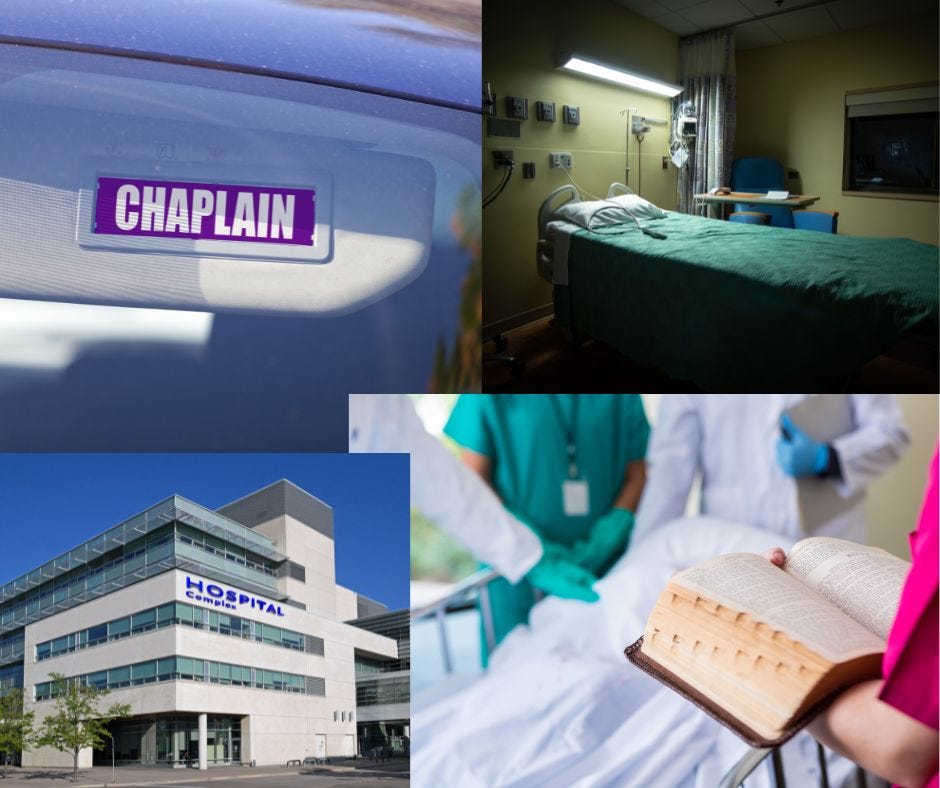
More Than a Chaplain
For someone who presumes himself to be smart, I can be pretty stupid sometimes.
My journey into hospital chaplaincy began in 2014. I was the solo pastor of a small, aging church that had high expectations of pastoral care from their minister. Recognizing my own inexperience, I suggested I complete a unit of Clinical Pastoral Education (CPE) at a local hospital.
They liked the idea.
So I worked six days a week, splitting my time between church and hospital—about 24 hours a week at each site. It was intense. The Monday after my unit ended, I was back at that same hospital having my appendix removed.
As they say in CPE: “The body keeps the score.”
My next venture into chaplaincy was in 2021. About three years into a new church start—and having slogged through the brutality of Covid, BLM, and the rest of 2020—I did the math and realized I needed to supplement my pastoral income.
Never quite getting the timing right, my second stint in CPE began in the summer, just before the brutal “second wave” of Covid. The church plant ended—perhaps mercifully—that spring. Even working only 28 hours a week in the hospital, the crush of Covid patients was brutal and exhausting.
Embarrassingly, through all that training, I still wasn’t sure it was for me.
I felt deeply called to the church (I still do). I carried this foolish notion that I wasn’t making much of a difference. I didn’t fully connect what I was doing in hospital rooms with my ministerial calling as a pastor.
After CPE, I returned to parish ministry. Then I worked a couple years in the social service sector. Neither role quite landed. So when the opportunity came to shift again—taking a mix of part-time roles, one of which included on-call chaplaincy—I took it.
Around that same time, I read Walk with Me, a sort-of memoir by Ellen Corcella about her experience in hospital chaplaincy. Something clicked.
Until then, I had subconsciously thought of chaplains as short-term religious therapists—there to offer a little prayer, a little comfort, a little presence in a crisis.
But reading her book, I realized something obvious and yet profound:
Chaplains, just like parish pastors, are ministers of word and sacrament.
Subtle but Enduring
While she shares gripping stories, mine tend to be quieter. Subtle. Enduring.
I am rarely “preaching a sermon.” And yet I often recognize that I am unmistakably sharing the gospel.
Just yesterday, I told a young man:
“God loves you. God forgives you. Receive God’s forgiveness for yourself.”
Sometimes I wonder if patients’ honesty is simply the result of being “hopped up on pain meds,” as a nurse once commented—or whether it’s something deeper. I’d like to believe it’s the latter. Hospitals, I think, force people to confront mortality in a way few other places do.
And in that confrontation, something opens.
I’m reminded of words attributed to Pope Francis—not a viral quote, but a verified one from the U.S. Conference of Catholic Bishops:
“I feel in my heart the ‘blessing’ that is hidden within frailty, because it is precisely in these moments that we learn even more to trust in the Lord; at the same time, I thank God for giving me the opportunity to share in body and spirit the condition of so many sick and suffering people.”
Hospitals are liminal spaces—fixed between life and death. Human beings enter through birth and depart through death, often within the same walls and at the same time.
A few weeks ago I remember sitting with a mom dealing with a horrific tragedy and hearing softly over the hospital speakers the jingle played when a new baby is born.
Perhaps that’s why, in this secular world where we’ve neutered nearly every aspect of the divine from daily life, I find myself drawn to crisis. I enter rooms aware that I am stepping onto holy ground.
A Title That Fits
I’ve grown to appreciate the title chaplain.
It feels less threatening than “pastor.” It allows me to honor my calling and use my degrees, while still wearing my faith openly. When I talk with nurses and staff, I make religious comments. I’m the chaplain—I can get away with it.
Before entering a difficult room, I’ll say to a nurse, “Pray for me.” Sometimes to lighten the mood. Sometimes to simply normalize talking about faith in a clinical environment.
But the deeper realization is this:
More than a chaplain, I am an evangelist.
I am sharing good news again and again.
“May I pray for you?”
“God loves you.”
“God forgives you.”
“God’s peace be with you.”
It may be anecdotal, but as a chaplain I keep encountering the same reality: people are hungry for forgiveness. Many have tried to persuade themselves they don’t need it. The effort itself seems to deepen the burden they carry.
I am a minister of the gospel—in word, and sometimes in sacrament.
I still hope that someday an opportunity may arise to serve again in a church in a professional capacity.
But for now, I am grateful.
Grateful that in hospital rooms, at the edge of life and death, I get to share the good news of God’s love.
it's the ultimate Cage Free ministry - being a chaplain. You're there in the midst of life and death - and people who need Jesus - every day.
I really appreciate this post. Having worked as a chaplain for over 12 years, I felt a gentle pull as I read along. "Hospitals are liminal spaces." In my experience, the veil was thinned in moments unexpected. The turn of a conversation toward the holy, or being present with a doctor's grief, would remind me to stay alert, as the spirit was always moving.