


TL;DR: Christian Smith is right that American religion looks bleak, but his own analysis—paired with Malcolm Gladwell’s idea of “tipping points”—leaves room to wonder whether small signs of spiritual hunger might be emerging. These hints are anecdotal, but they suggest we should pay attention, pray, and stay faithful in the long, slow work of renewal.


So, this is really the biggest question—is there any evidence that something might be shifting within America or even the broader cultural West in favor of a religious awakening?
Smith, as a good researcher does, is very cautious about making predictions. He basically says you might see a slowing of decline, but a mass revival seems unlikely. Fair.
But then he writes this line, which is ultimately what convinced me that his work belongs in conversation with Malcolm Gladwell:
“Big shifts can be under way for long periods without apparent consequences until they reach a tipping point or critical mass, when everything changes.” (365)
For my purposes here, I’m simply paying attention to any hints that there might be something afoot. Yes, Smith paints a bleak picture for Christianity in America, but the moment Gladwell described with Hush Puppies shoes keeps rattling around in my head—where something relegated to the cultural bargain bin suddenly resurfaces because a few people rediscover it for precisely the reason it didn’t fit the moment.
Since the Asbury Revival, I’ve wondered if something similar—even at a micro scale—might be stirring. And while these examples are mostly anecdotal, they still make me pause.
Example 1: A Reaction to Neoliberal Exhaustion?
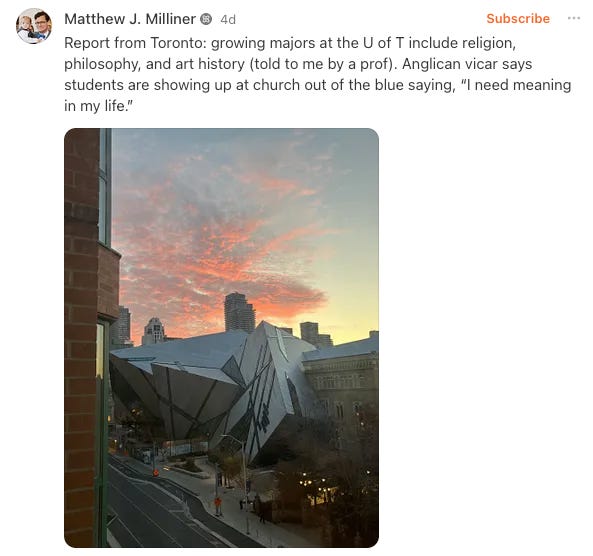
Smith notes that neoliberalism has become, in many ways, America’s de facto religion:
“Money… the one common reference of value.” (137)
It’s not shocking to imagine that younger generations—alienated by a dysfunctional economy, student debt, and the disappearance of the middle class—might be less enchanted by money-as-god. If economic gain feels hopeless, maybe something deeper, older, and more grounded becomes appealing again.
Example 2: A Hunger for the Holy in a Flat, Digital World
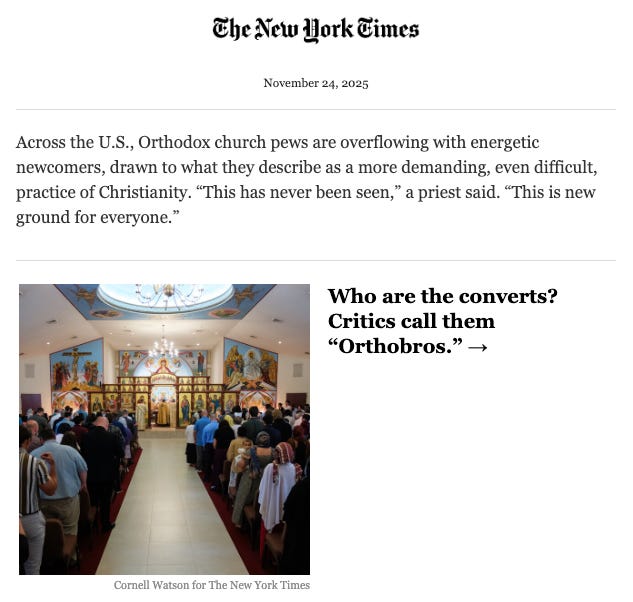
A friend sent me a screenshot recently that, along with the one at the top of this post, is part of what pushed me into writing a Part 3.
Smith writes that cultural shifts happen:
“less through conscious belief formation, more through the repetition of concepts and images that evoke powerful emotions.” (176)
In my highlights, I noted: this is why worship and liturgy matter.
In a world that is flat, controllable, predictable, and endlessly optimized, worship and liturgy open us up to the un-controllable. And in a world where discomfort can be instantly numbed with a dopamine hit—scrolling, streaming, swiping—is it surprising that some people start reaching for something different?
Something ancient. Something embodied. Something reverent.
Example 3: Secularism Didn’t Win—Religious Counterfeits Did
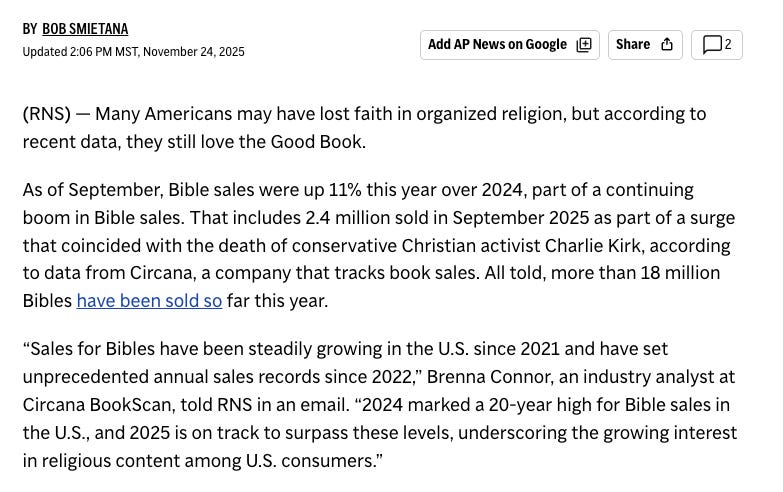
Smith writes:
“Religion lost out in good measure because alternatives that are actually more like religion than secularism emerged as cultural options that proved attractive to many post-Boomers.” (335)
He’s clear secularism hasn’t “won the day.” It’s more that politics, fitness culture, therapy-speak, fandom, and niche communities did religion better for a while.
If that’s the case, then it’s not inconceivable that the trends could swing again.
**Everything Above Could Be Nothing…
…but it also could be the start of something.**
Again, these are all anecdotal, scattered, and small. Maybe they’re historical one-offs. Maybe they’re unrelated. Maybe they’re nothing.
But as Smith and Gladwell both note, tipping points only happen when the right mix of context and the right mix of people come together.
Which means it’s worth paying attention.
And honestly, it’s worth praying for.
And that leads me to at least a few things we can do right now—whatever the larger cultural forces are doing.
1. Pray.
Enough said.
2. Know your role, and do it.
Gladwell’s categories matter here: information mavens, connectors, salespeople.
I’m clearly an information maven.
Some of you are connectors.
Some are salespeople (and I mean that in the best sense).
We need the salespeople to articulate why Christianity matters—not bland spiritual relativism like, “I like community” or “It helps me be a good person.” Tell people why Christianity matters. Tell stories of brokenness, surrender, and transformation.
Connectors help introduce people to the right spaces, conversations, and communities. (I need some more of you connectors to connect me with more people!)
Information Mavens help gather and articulate the ideas that shape imagination—what I’m hoping to do in this series especially!
All are needed.
3. Stop selling buildings. Seriously.
For the love of all that is good and holy, stop selling church buildings if at all possible.
Sure—if you’ve got a mid-mod monstrosity literally falling apart, okay. But in a world stripped of the holy and the enchanted, people genuinely wander into iconic church buildings because they sense “something more” might be inside.
A denominational leader once told me they “weren’t in the property management business.”
Friend… that’s the absolutely wrong attitude.
Buildings aren’t just assets. They’re witnesses.
Let me close with this.
Roxburgh and Searle, in the book Forming Communities of Hope in the Great Unraveling, argue that things are going to be dark for a while. I can’t disagree. Even Smith notes that the obsolescence of American religion didn’t happen overnight—it unfolded over roughly twenty years (1991–2009).
If these examples above are indeed the beginning of something, they’re the beginning of something that will take a long time.
Let me repeat that:
It will take a long time.
What Roxburgh and Searle encourage—and what I’m trying to lean into with these three small suggestions—is that we must do faithful things now, even when the landscape looks bleak, trusting that God can bring renewal and resurrection in time.
This is not a strategy.
This is not a program.
This is not a pitch deck.
This is just… faithfulness.
And maybe—just maybe—faithfulness is exactly the kind of thing that tips.
Can American Religion Reach a Tipping Point?

TL;DR Christian Smith argues that American religion declined because culture shifted and churches lost their distinctiveness. Malcolm Gladwell argues that big change happens when small actions accumulate into a “tipping point.” Taken together, both suggest that renewal in American Christianity—if it comes at all—will depend on context, a compelling messa…
The battle is a long long one! Also agree - Stop letting go of beautiful buildings! Space matters!
I know what you are trying to say, but no “salespeople.” But yes to stories. Not bland ones.