


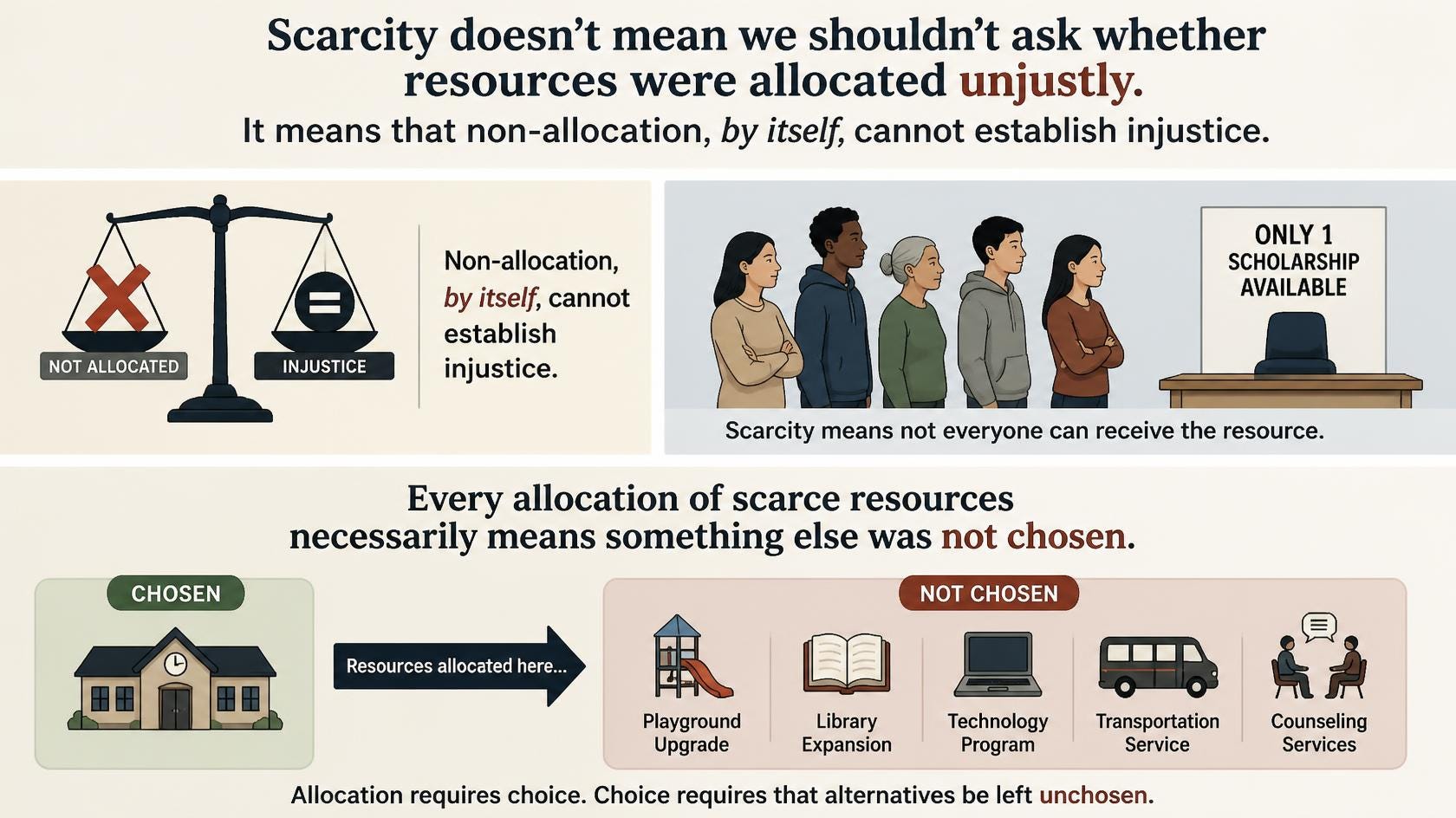
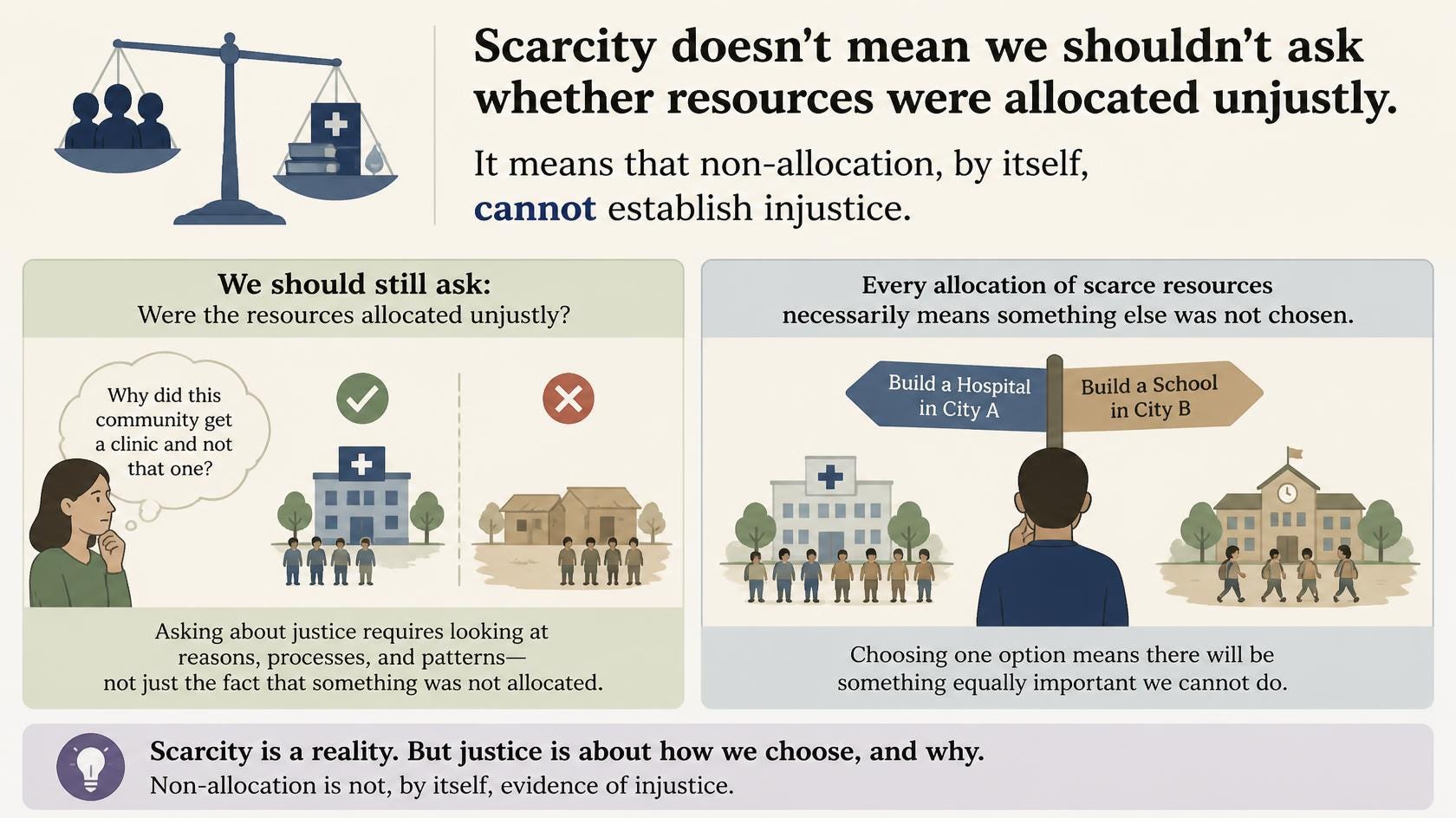
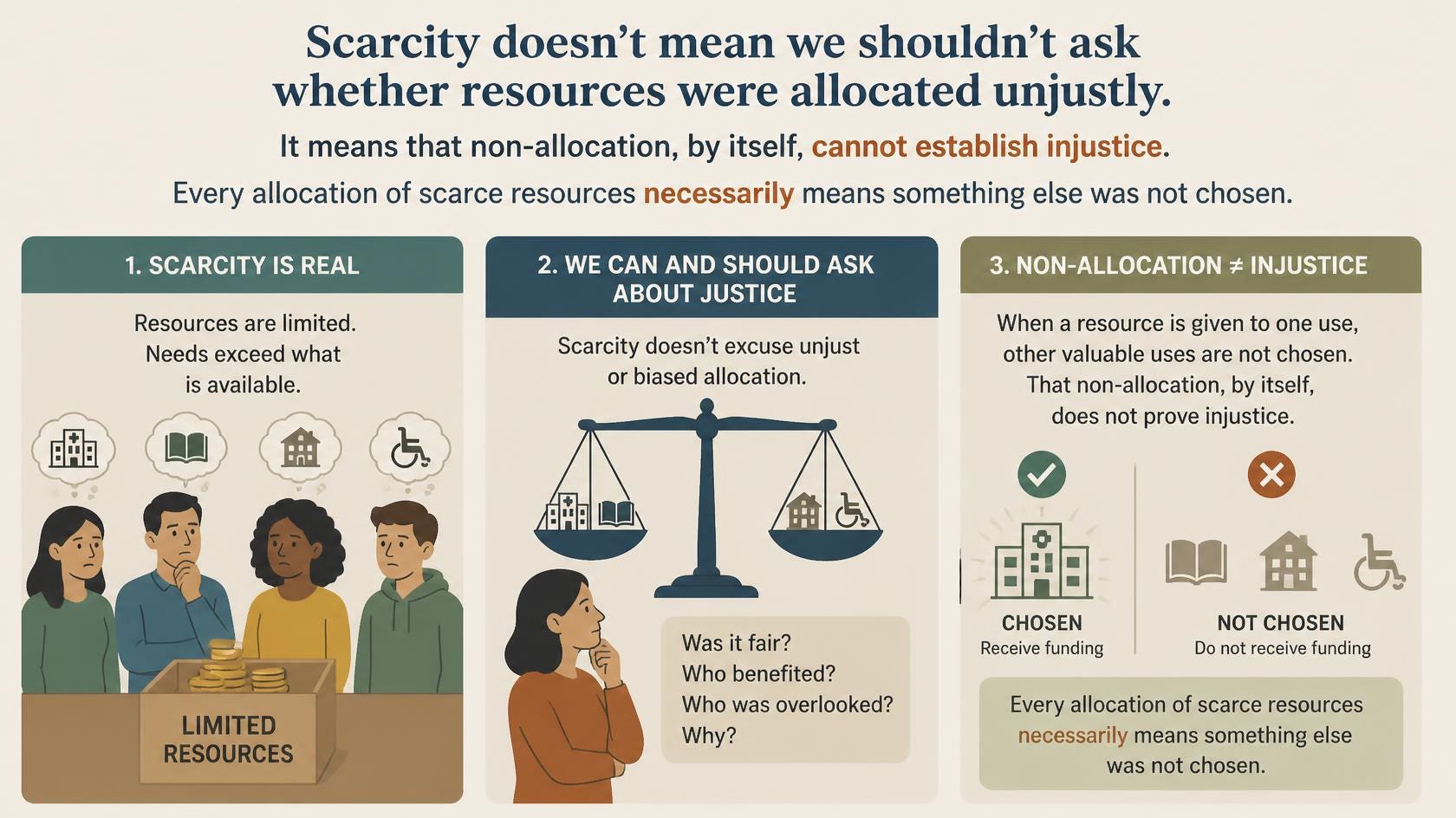
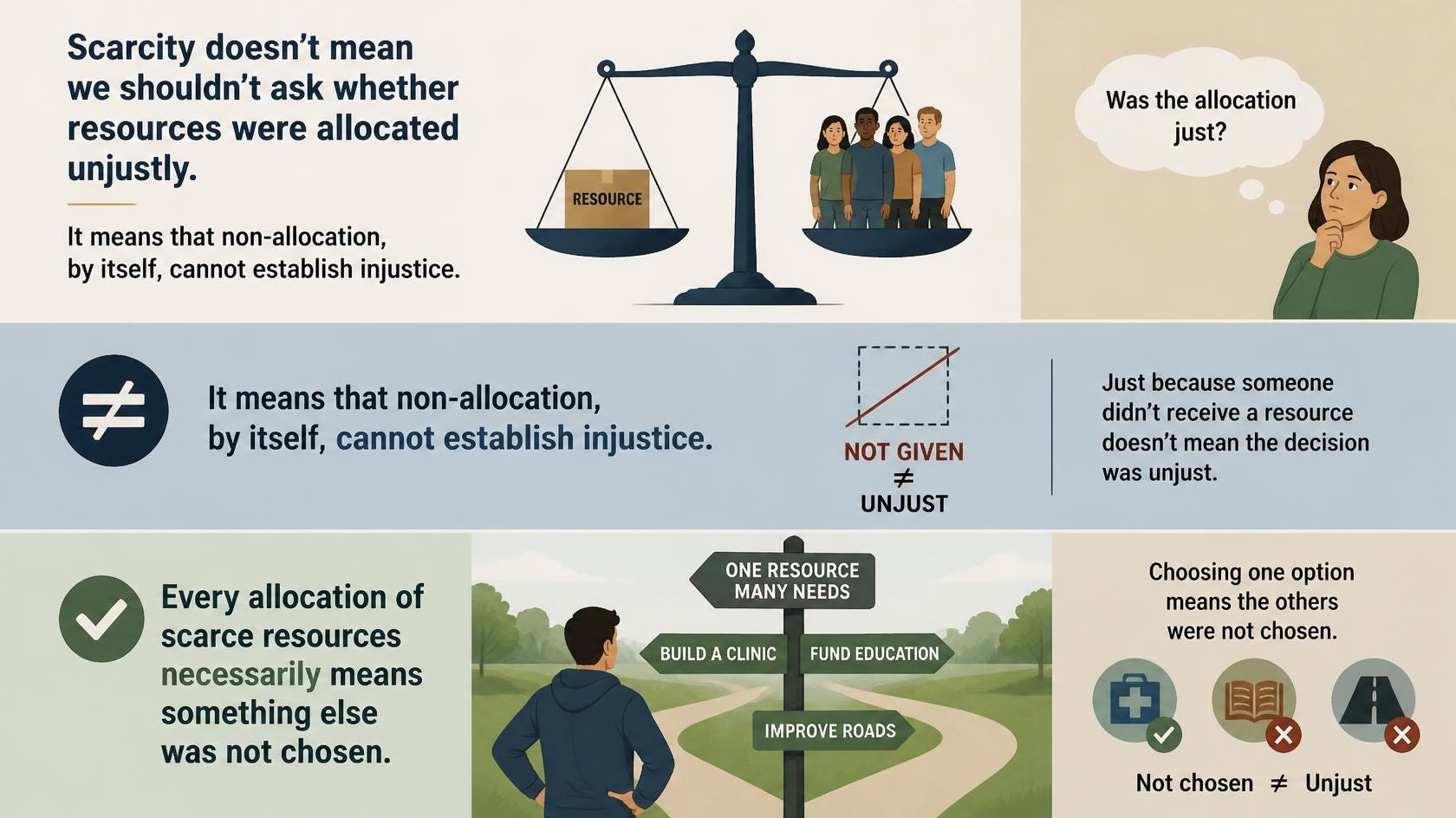
TL;DR: Scarcity doesn't mean we shouldn't ask whether resources were allocated unjustly. It means that non-allocation, by itself, cannot establish injustice. Every allocation of scarce resources necessarily means something else was not chosen.
A quick aside: I should post something about my new book released this week. I’d rather do instead what the book is ultimately about—thinking and sharing ideas. That being said, if you haven’t already done so, please check out the book.
Increasingly, I’ve been thinking about a pretty basic economic reality: Scarcity forces choices between good things.
There is never enough time, money, attention, labor, or capital to do every good thing we might want to do.
Economics, at its most basic level, is about how we make choices amid those constraints.
Yet increasingly, especially within progressive spaces—of which I consider myself a part—I notice a tendency to moralize those choices. If something good doesn’t receive resources, the assumption can quickly become that someone—or some system—denied it those resources.
But those aren’t necessarily the same thing.
I recently came across a social media post referencing the early years of the league in contrast to the recent growth of the WNBA. It included this line:
“They played despite systemic denial of resources and media, as did the women who followed, chipping away for decades at the myth that no one watches women’s sports.”
I found myself getting stuck on the phrase “systemic denial.”
There’s no question that women’s professional basketball historically received less investment, media coverage, and attention than men’s professional basketball.
That’s an observable disparity. But systemic denial makes a different claim.
Denial makes a causal claim: that something or someone prevented those resources from being allocated. And more importantly, it assumes that because resources went somewhere else, they should have gone here.
But again: scarcity forces choices between good things.
One note before I get myself in trouble here: I’m trying to approach this with some humility. I’m not an economist, and I’m certainly not arguing that discrimination doesn’t impact economic outcomes—it obviously has and still does. What I’m trying to tease apart is something much narrower: Does an unequal distribution of resources itself tell us why those resources were distributed unequally? I’m not convinced it does.
Disparity Tells Us What Happened, Not Why
There is a tendency, particularly in progressive analysis, to treat unequal outcomes as prima facie evidence of discrimination.
Group A received more resources than Group B. Therefore, some system unfairly advantaged Group A or denied resources to Group B.
Sometimes that’s exactly what happened. History certainly gives us plenty of examples—redlining being a prominent example—but the existence of a disparity doesn’t establish its cause.
Consider the early WNBA.
The league certainly received less investment and attention than the NBA. But it was also a brand-new professional sports league competing for an audience. More importantly, it wasn’t simply being starved of resources.
The NBA created and financially supported the WNBA. Before its first season, the league secured national television agreements with NBC, ESPN, and Lifetime.1 And the NBA continued subsidizing the WNBA despite the league losing money for years.2
That doesn’t prove sexism played no role in women’s sports—it very well could have. But describing the early WNBA as suffering from the “systemic denial of resources and media” leaves out some rather important facts.
From a July 2025 article: “the NBA’s backing remains a pillar of the WNBA’s existence. And while the hope is for the WNBA to one day thrive on its own, for now, it’s clear that the NBA’s support is not just helpful — it’s essential for the league’s future.”
People were investing in it even when the economic return didn’t necessarily justify the investment.
Investment Isn’t Charity
This gets to something I’ve increasingly noticed in conversations about economics.
A lack of investment—or even simply less investment—is often treated as evidence of bias.
But businesses generally don’t exist to distribute resources according to what people deserve. They invest capital where they believe there is sufficient opportunity for a return.
I think this is a key point worth diving a little deeper into.
As a Christian, I’d say all people deserve access to basics like food, housing, and community. But saying someone deserves something doesn’t answer the question of how we actually provide it.
The question isn’t simply whether people deserve something. The question is whether—and how—we can deliver it.
And that’s ultimately an economics question.
We’re seeing something similar in philanthropy. Increasingly, philanthropists want to see evidence of impact from their gifts. They are less inclined to give to something simply because it is a worthy cause. After all, there are countless worthy causes competing for the same finite pool of resources.
So beyond basic business and investor questions like: How large is the potential audience? What revenues can we reasonably expect?
There are also more practical questions: What’s the risk? What else could we do with that money? Do we even have enough money?
Those aren’t necessarily moral judgments. They’re economic ones.
If one restaurant receives a $5 million investment and another receives $500,000, we cannot conclude from those numbers alone that the second restaurant was discriminated against. We need to know something about their markets, revenues, business models, risks, growth prospects, and expected returns.
Perhaps investors underestimated women’s basketball because of sexism—that very well could be the case and is worth examining.
But, it’s also possible that early investors observed that the audience at the time was smaller and therefore saw greater financial risk.
Perhaps both were true.
But those are empirical questions. The disparity itself doesn’t answer them.
To claim there was a systemic denial seems to me to require some evidence of the denying.
And in the case of the WNBA, at least, there seems to be significant evidence complicating that description: people were investing substantial resources despite uncertain or inadequate financial returns.
Churches and Nonprofits Aren’t Exempt From Scarcity
And this is where I think churches and nonprofits should pay particular attention.
We believe deeply in the importance of our work—we very much should.
But that can make it easy to assume that other people should support that work—with their donations, attendance, volunteer hours, or other resources.
And when they don’t, we can interpret that as evidence that they don’t care enough about our cause.
But that misses something fundamental about economics: Economics is about tradeoffs.
Money given to one organization cannot also be given to another. An hour spent volunteering at my church cannot also be spent volunteering at the food bank. A foundation investing $100,000 in affordable housing has $100,000 less available for childcare, environmental work, or any number of other worthy causes.
None of those decisions necessarily tells us how much someone cares about the thing they didn’t choose.
Scarcity forces choices between good things.
A donor who doesn’t give $1,000 to your church may have given it to a food bank.
A volunteer who can’t serve your ministry may be caring for an aging parent.
A foundation that declines your grant may be funding affordable housing instead.
Not choosing our good thing doesn’t mean they don’t care about good things.
It means their resources have limitations also.3
Certainly, this doesn’t relieve churches and nonprofits of the responsibility to demonstrate the impact of our mission. We should be able to explain why our work matters and why someone should invest their limited resources in it.
But even when we do that well, we’re still competing—not necessarily against bad or selfish uses of resources, but often against other perfectly good uses of them.
That’s the tradeoff.
When Economic Outcomes Become Moral Narratives
This is where I think the disagreement becomes deeper than the WNBA.
Different frameworks begin with different questions.
One framework encounters a disparity and asks: Who had the power to create this disparity? Who benefited? Who was excluded?4
Traditional economic analysis tends to ask: What incentives, risks, scarcity, opportunity costs, and market conditions produced this outcome?
Both sets of questions can reveal something important.
My concern is what happens when the first framework becomes so dominant that ordinary economic explanations themselves begin to look morally suspect.
Less investment becomes “denial of resources.”
A smaller audience becomes evidence of systemic bias.
A business declining to invest becomes an ideological statement about whose work it values. And suddenly an economic outcome has become a moral narrative populated by oppressors and victims.
But sometimes also, a denial of resources is due to systemic bias. Redlining is one prominent example. Neighborhoods were purposely underinvested in, often explicitly because of race. Bias became systemic and produced disparities that lasted for generations.
So, I’m not trying to say that every economic decision is purely rational or nobly virtuous around making money. We KNOW that’s not true.
The point I’m seeking to distinguish isn’t that discrimination never happens, but rather that it doesn’t always explain unequal outcomes.
Sometimes people simply don’t want to lose money. And sometimes they chose to put their money somewhere else.
The WNBA May Actually Demonstrate the Opposite
And this is what makes the WNBA example so interesting.
The early league wasn’t financially self-sustaining. Yet powerful institutions continued investing in it anyway. They were essentially betting that an audience could be developed over time.
And now, decades later, we’re watching that happen.
A sparsely attended game early early in the WNBA and an arena packed with 20,000 fans in 2026 don’t necessarily tell a story about an audience that was always there but systematically suppressed.
It might also tell a much more ordinary—and frankly fascinating—story about market development.
A league was created, money was invested, financial losses were tolerated, players became stars, generations of fans encountered the product, media attention grew, the cultural environment changed, and and eventually demand increased dramatically.
None of that requires us to pretend discrimination doesn’t exist.
It simply requires us to distinguish between disparity and discrimination.
Scarcity Isn’t (always) a Moral Failure
I think where I’m ultimately going with this is that the moralizing of economic outcomes aligns well with the “hermeneutic of suspicion” that characterizes much progressive thought: when we encounter a disparity, we go looking for the person, institution, or system responsible for creating it.
Sometimes that suspicion is warranted—people ARE being stingy and selfish.
But I don’t think suspicion is a particularly healthy starting point for understanding every economic outcome.
And for churches and nonprofits especially, it can relieve us of the responsibility of reckoning with scarcity.5
If someone doesn’t donate to our organization, it doesn’t necessarily mean they’re selfish.
If someone doesn’t volunteer at our church, it doesn’t necessarily mean they don’t care about our mission.
And if investors didn’t invest more money into the WNBA thirty years ago, the disparity alone doesn’t tell us why.
Again, a reckless pursuit of profit has been detrimental to people, communities, and ecosystems. And people ARE worth far more than the measure of their economic productivity.
But as I’ve tried to argue throughout this series, economics is ultimately about how we handle the very real constraints of people, time, resources, and capital.
Perhaps the WNBA would have grown faster had early investors provided EVEN MORE investment. Maybe greater media coverage would have created greater demand sooner. Those are entirely plausible arguments.
But someone still had to provide that capital. Someone had to absorb those losses. And every dollar invested in the WNBA was a dollar that couldn’t simultaneously be invested somewhere else.
The same is true for every dollar donated to a nonprofit and every hour volunteered at a church.
Scarcity doesn't mean we shouldn't ask whether resources were allocated unjustly. It means that non-allocation, by itself, cannot establish injustice. Every allocation of scarce resources necessarily means something else was not chosen.
Which is why I keep coming back to the language that started this whole piece. Less investment is an observable fact. “Denial” is an explanation, and explanations require evidence.
Sometimes the reason one good thing receives fewer resources isn’t because anyone denied its value.
Sometimes people simply chose another good thing.
https://www.spokesman.com/stories/1997/aug/12/catching-on-if-nothing-else-wnba-is-a-hit-with/
https://www.essentiallysports.com/nba-active-basketball-news-does-nba-subsidize-wnba-all-financial-details-revealed-after-all-star-weekend-message/
Certainly there is an argument to be made for encouraging greater generosity—but I think much of the problem is that too often we can seek to prescribe what it means to be good. Meaning, to be good means supporting this cause.
I’d also agree that power should be examined as power tends to be protected and perpetuating.
“Reckoning with scarcity” - I’m going to have to write a 5th blog in this series on this line!


Hi. I like the general point you are making here, but I felt the article itself redundant and circular.
I was about to send this comment, but then realized it might sound too harsh if read out of context. I've been a faithful follower for at least a couple years. So the comment is just about a constructive critique. Hope it helps!